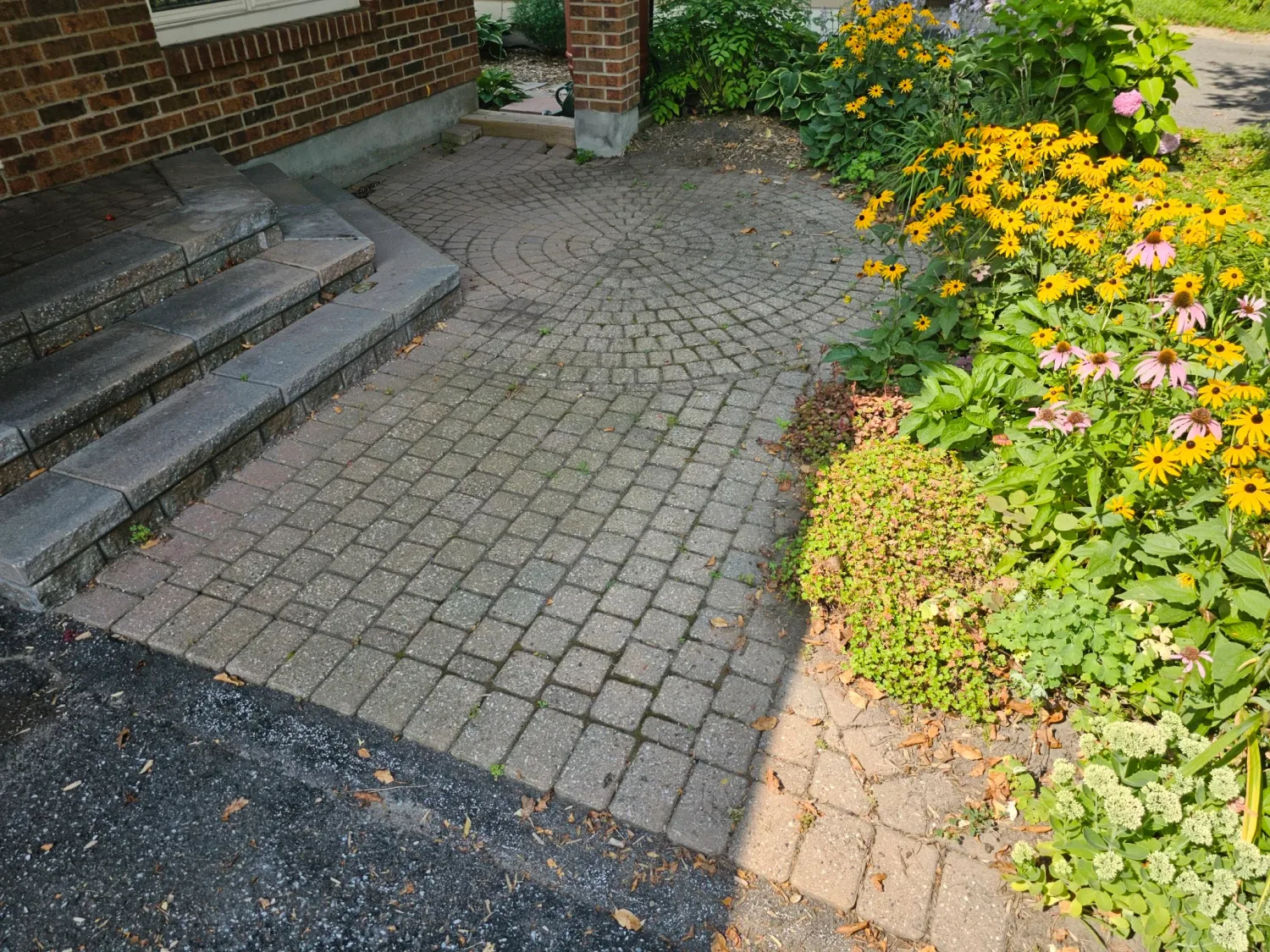
 Before
Interlock Restoration · Step 1 — The Restoration
Joints rebuilt. Stones stay. No coating.
Interlock pavers themselves can last decades. The joints usually don't. Once the sand erodes and weeds move in, most companies just quote a full replacement. In the majority of cases, restoration solves the same problem for a fraction of the cost.
What Natural Finish Is
The look your interlock was meant to have.
Natural Finish is a complete restoration with no surface coating: joints rebuilt with Techniseal HP NextGel, vibration-compacted and levelled precisely, leaving the natural stone look. Flexible joints suited to Ottawa's freeze-thaw — engineered movement instead of cracking.
No coating does not mean nothing is being protected. Conventional interlock is impermeable paving — a build type, not a promise. It is meant to shed water to the edges rather than take it down through, and the joints are part of that surface. Permeable paving is the other kind entirely: open stone the whole way down, no fines to lose, built to take water in on purpose.
Once the sand is gone, the joint stops shedding water and starts collecting it. Rain that should run to the edge instead drops straight down into the bed. A bed that keeps taking water on stays wet, the fines soften and start moving, and the stones settle into the space that opens up. That's where the dips come from — the joints let the water in, whatever the bedding is made of.
Rebuilding the joints puts them back to work and cuts down how much water gets in there. It is not waterproofing — no interlock surface is, and it is not meant to be. And it will not lift a dip that is already there: where the bed has already gone soft, new joints buy that surface time rather than fixing it. That one is a lift and relay, and you will hear it from us at the assessment rather than afterwards.
It's the right choice for most driveways, for anyone who prefers the natural stone look, and for anyone who wants to prove the joints before deciding on a sealer. A properly restored surface doesn't actually need a coating — the structural protection already happened in the joints. That's why sealing is Step 2, and optional.
From $1,050 +HST — a typical two-car driveway lands in the $1,800–$2,250 range
Price my interlock restoration →Before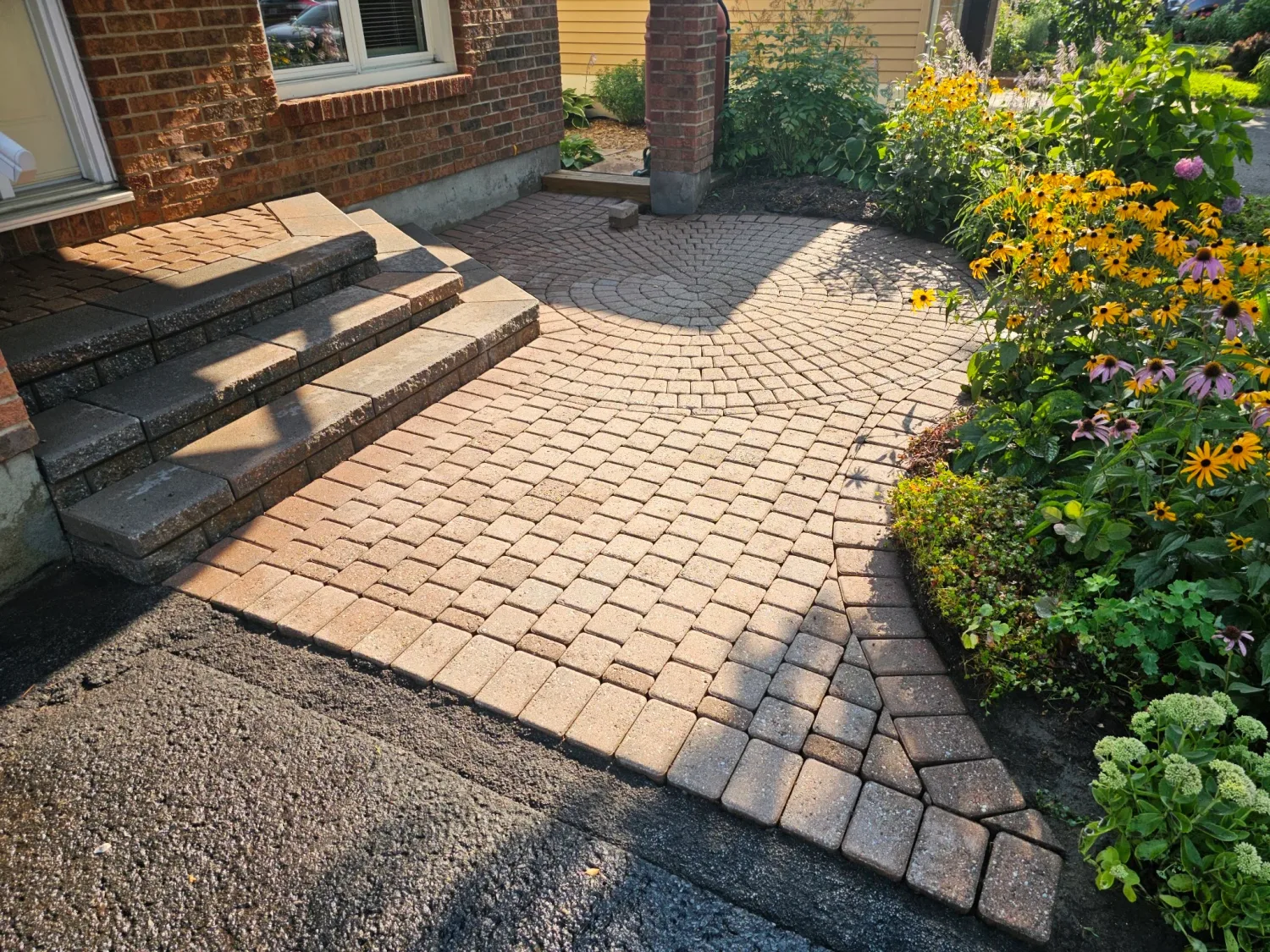 After
After"The interlock looks terrific — many thanks for all of your hard work over the past few weeks."— Kate · Interlock driveway restoration client
What Makes Ours Different
Why re-sanding alone doesn't last — and what we do differently.
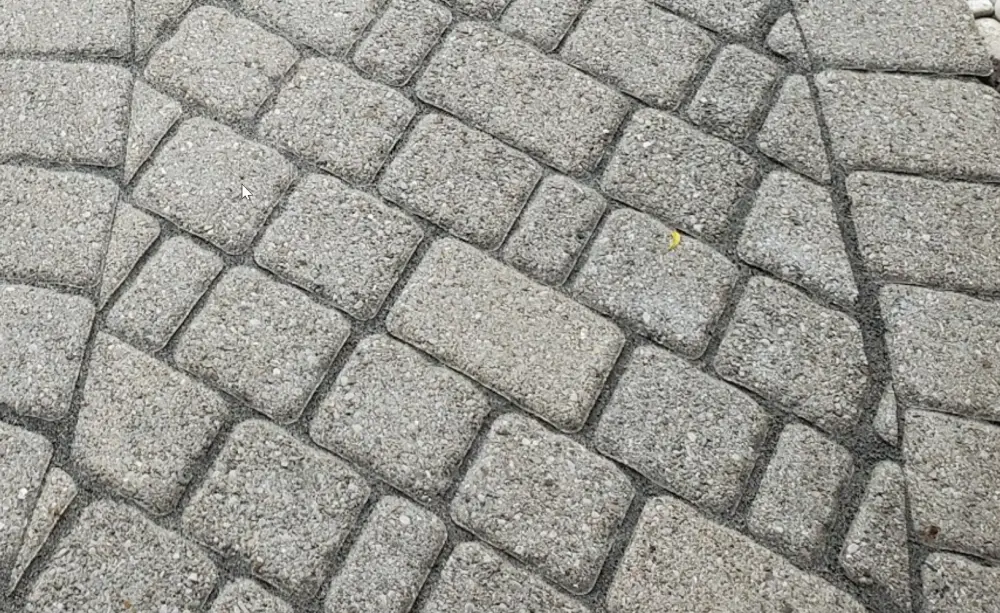
Most re-sanding jobs follow the same basic process: remove old sand, clean, re-sand. It looks good on day one. By the following season, the weeds are back — because the root crowns living protected beneath the old jointing compound were exposed but never treated. Re-sand over them and you've sealed the problem back in with fresh material.
Before any new sand goes in, we can treat every open joint with commercial-grade saturated steam. Delivered straight into the joint channel, it reaches depths you simply can't treat on an intact surface and kills the exposed roots at the source. The steam itself is nothing but water — no chemicals, no residue — and treated joints are safe for kids and pets as soon as they cool.
Where there are weeds in the joints, steam treatment is part of the restoration rather than an extra line on the bill — it goes in before the joints are refilled, because burying a live root system under new sand only delays the problem. On joints with no weed growth there is nothing for it to kill, so it comes off the quote.
The Process
Eight steps. No shortcuts.
Two visits, and each stage waits for the right conditions.
- 01
Agree the scope
Surfaces to restore, the process, and your chosen polymeric sand colour — in writing before work begins.
- 02
Assess
Any corrections or adjustments worth making first get flagged — including areas that should be re-levelled before they qualify for warranty.
- 03
Extract the joints
Full removal of old polymeric sand and weeds from every joint — cleanly, without mess.
- 04
Clean the surface
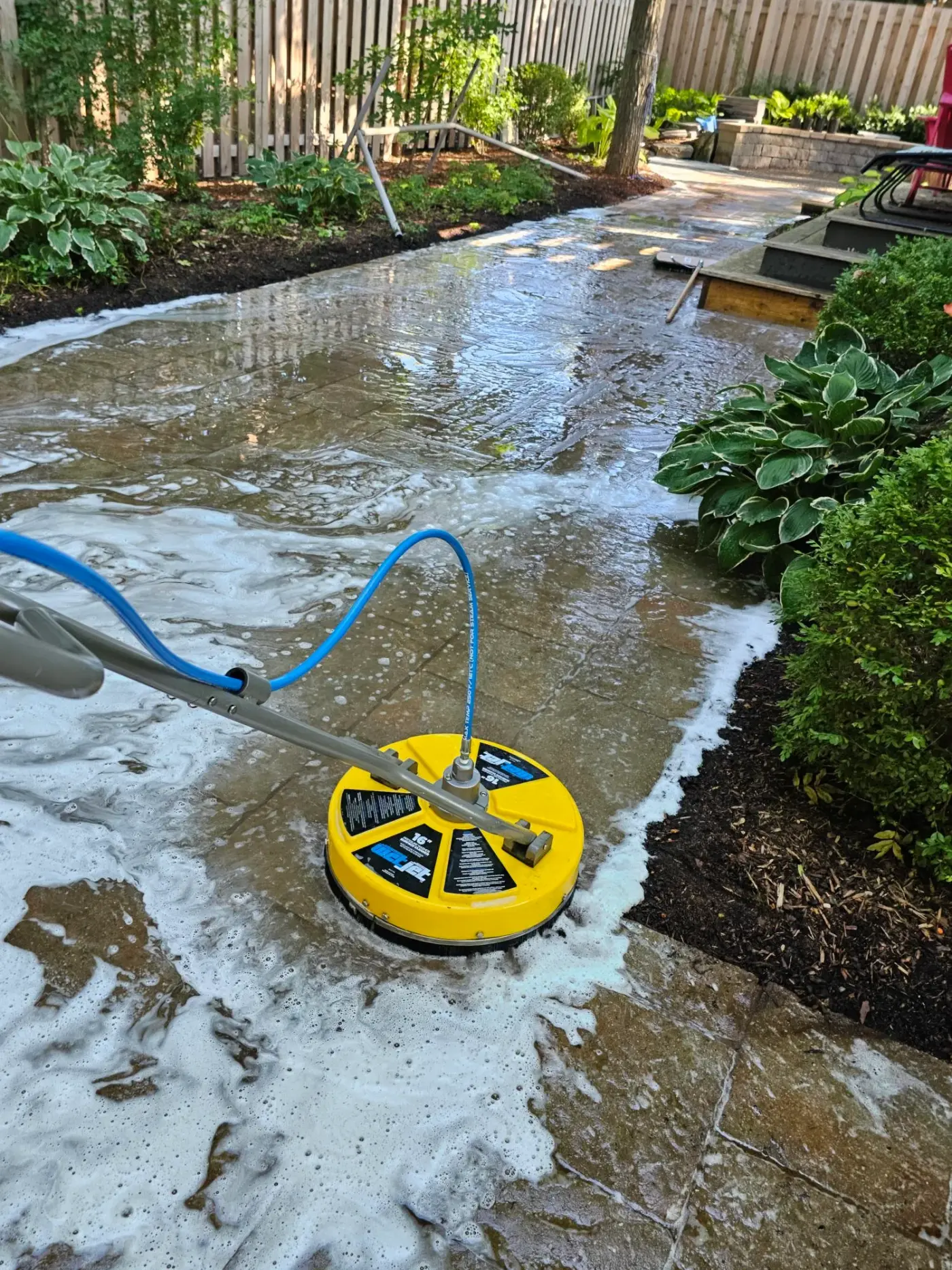
Commercial hot-water pressure washing with a rotating surface cleaner.
- 05
Steam the open joints
Optional, and included when your joints have weeds in them. Saturated steam at over 100°C goes into every open joint channel and kills the exposed roots — which is why they do not grow straight back. Where nothing is growing, there is nothing for it to do.
- 06
Dry
A hold period until the work area is completely dry — sand performs only in dry joints.
- 07
Re-sand & compact
Premium polymeric sand installed, then compacted with a vibrating plate fitted with a protective pad.
- 08
Level & set
Precise brooming and blowing to the correct joint depth, then a final wetting to activate and set the sand.
What We Use And Why
Named products, chosen for Ottawa's climate.
Techniseal HP NextGel polymeric sand
The premium jointing sand — selected for driveway-grade load capacity, humidity resistance in Ottawa's climate, and the strongest available resistance to weed growth, insect intrusion, and erosion. Compacted and levelled, it's what keeps joints stable and low-maintenance for years.
Commercial saturated steam
Delivered at over 100°C directly into open joint channels — contact kill of the exposed roots, with zero chemical residue. This is the step that separates a restoration that holds from one that needs redoing in a season.
OxyShock MAX surface cleaner
A professional oxygen-based organics cleaner used on the pavers and joints during restoration — and on the annual maintenance visit. It leaves the surface cleaner for longer than a standard wash. A cleaner, not a coating.
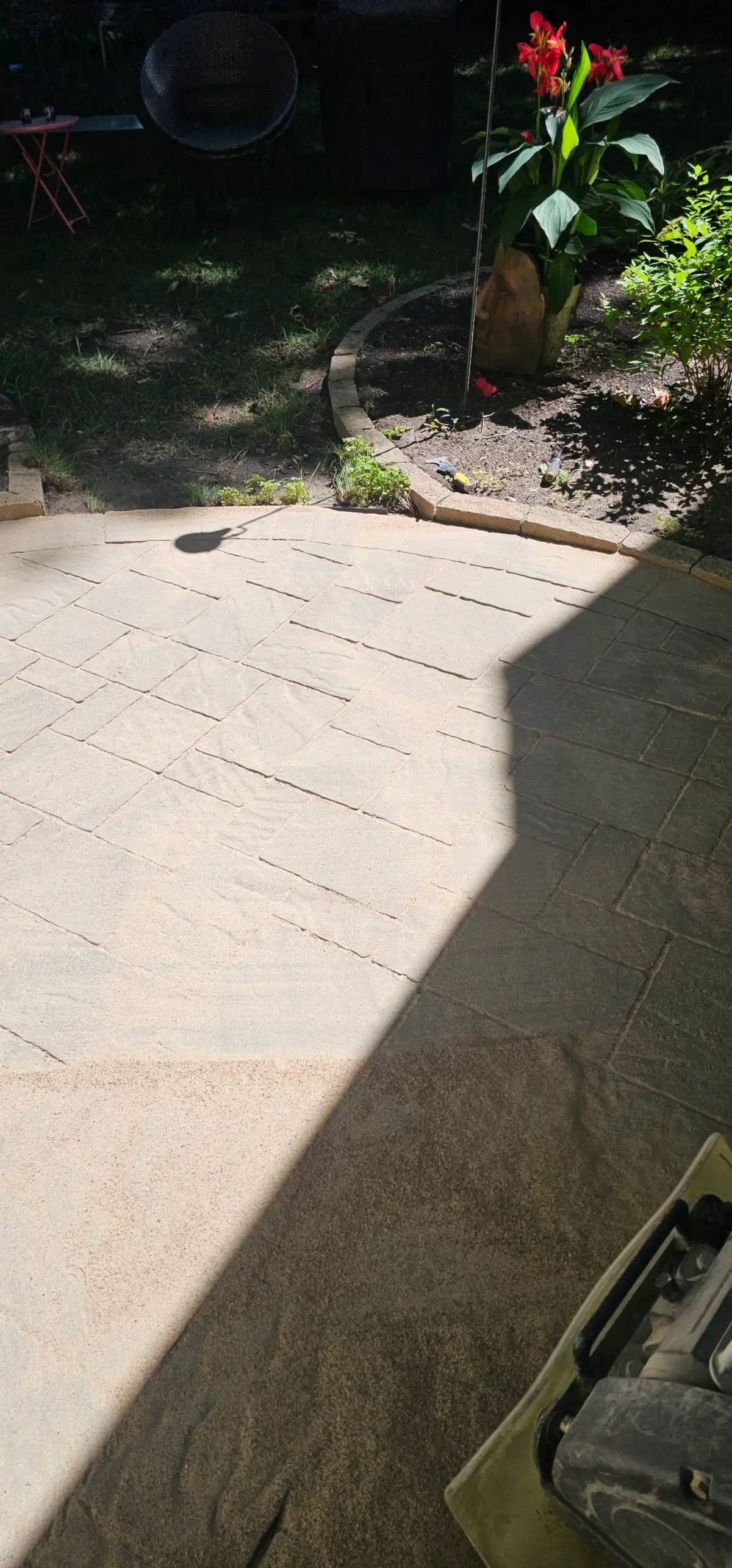
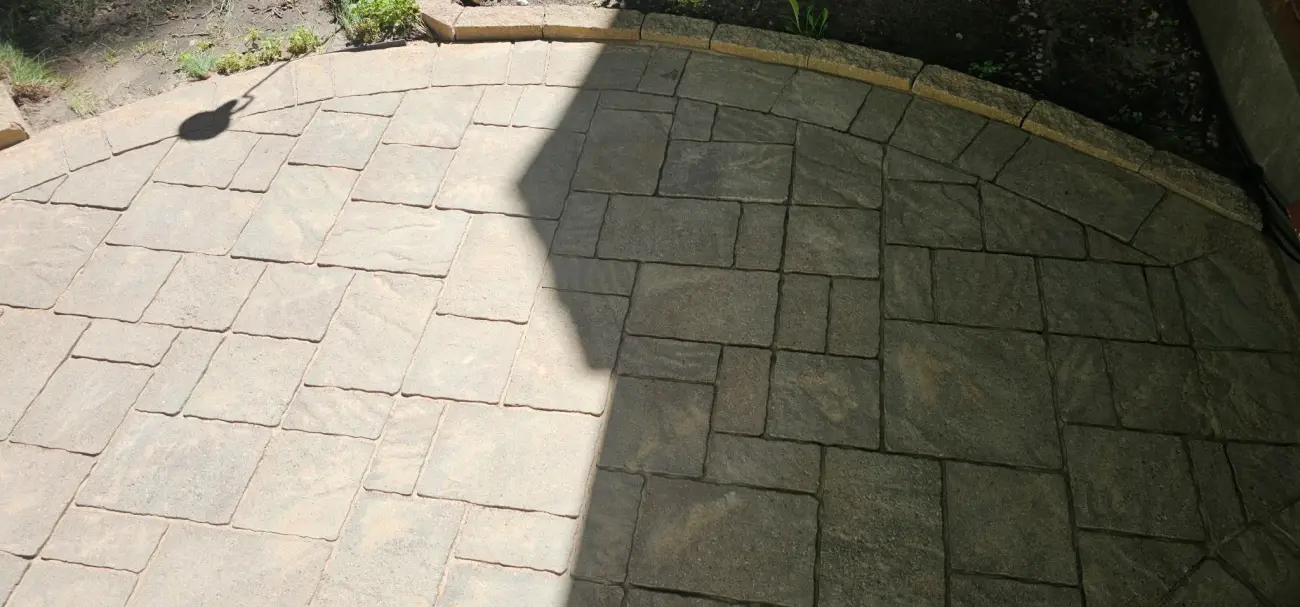
Same patio, same day. Compaction drives the sand down into the joint — so we top the joints up after compacting, then level and set. Skipping that top-up leaves joints low, and low joints fail early.
When Stones Have Moved
Heaved or sunken stones get re-set, not worked around.
Some surfaces need more than joints: frost has lifted stones, or gaps have opened wide enough to invite the lawn in. Those areas get repaired as part of the restoration — stones lifted, bedding re-screeded, everything re-set flush before the joints are rebuilt.
It's also what the assessment is for: areas that should be re-levelled get flagged up front, because level, properly-set surfaces are what qualify for the joint warranty. How a lift and relay works →
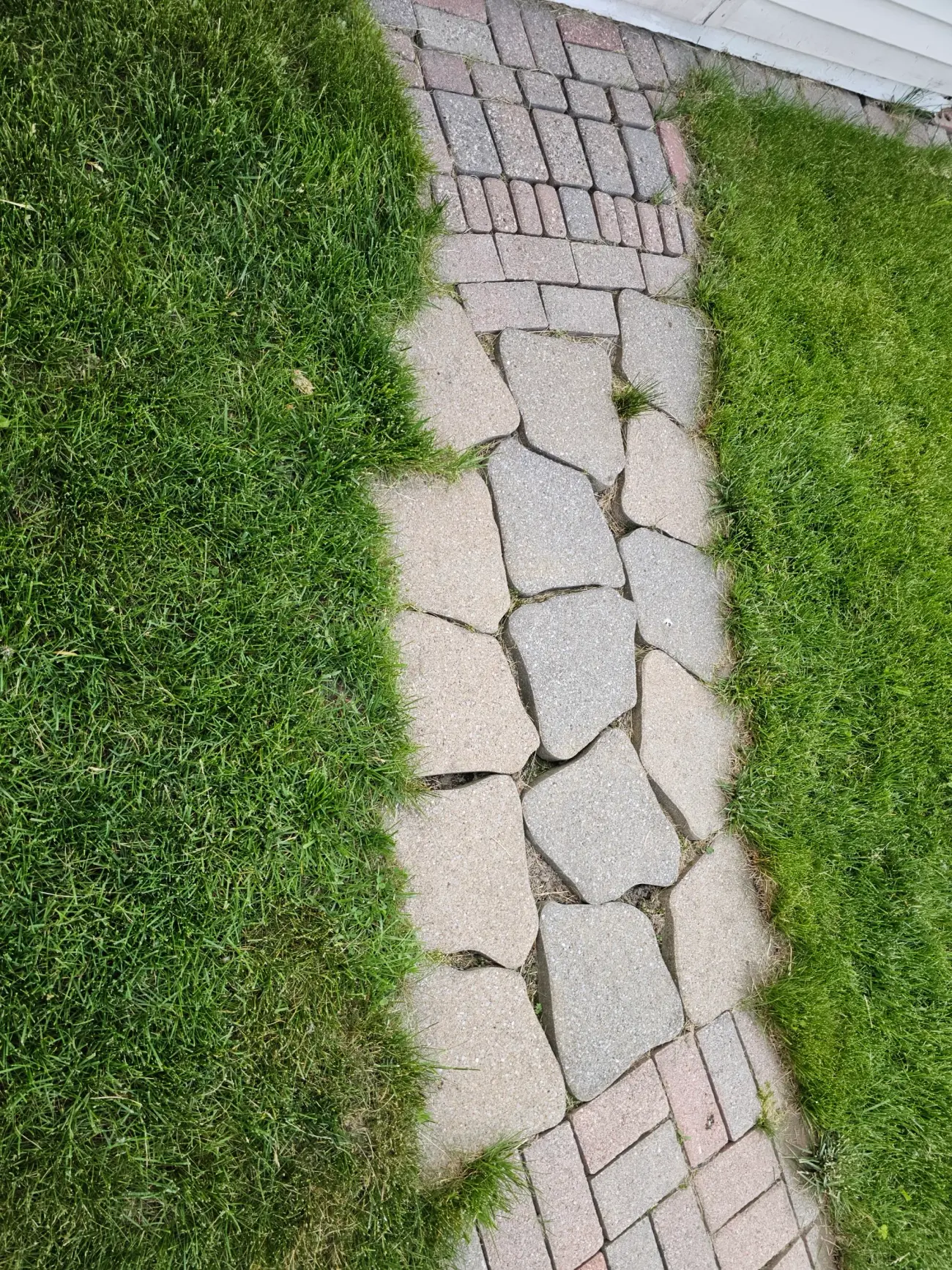 Before
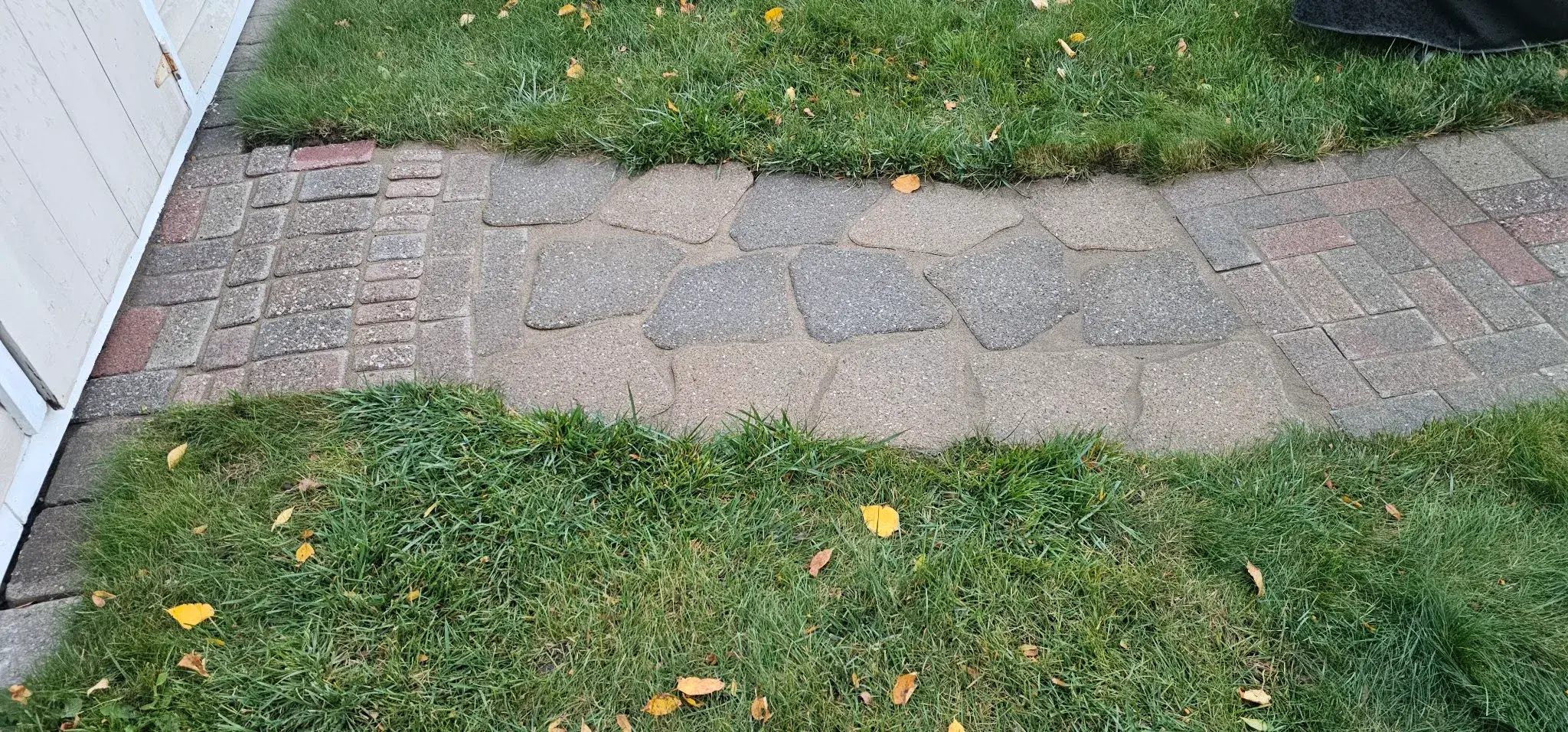 After
AfterSeal Later If You Choose
Every Natural Finish is Seal & Renew-ready.
Once your new joints have cured 30+ days, your restoration qualifies for Interlock CAT5 Seal & Renew — the CAT5 satin finish, applied over joints we know are sound because we built them. Restore now, evaluate the result, seal this season or next. No penalty for waiting.
The joint warranty in plain terms.
Surfaces that are level (or that we properly level) carry a 3-year joint warranty on the work itself. That extends to 5 years if you stay on the Annual Maintenance & Warranty program — a yearly professional clean and inspection. Sunken or pooling areas we flag at assessment are excluded unless corrected, and what's covered is documented before the job starts.
Good To Know
Common questions.
What about oil, rust or paint stains?
The restoration's deep clean handles organic staining — moss, algae, grime. Extraordinary stains are their own trade: oil takes degreasing, rust takes a dedicated remover, paint and efflorescence each have their own treatment. David assesses them at the free on-site visit and any specialty treatment appears as its own line on the proposal, so you see exactly what chasing the stain costs before deciding.
How long does a restoration take?
Two visits: the first cleans and extracts the joints, and steams them where weeds are growing; the second, once the surface is fully dry, sands and compacts. Each stage needs the right conditions (especially a fully dry surface before sanding), and we don't rush stages that determine how long the joints last.
Will the weeds come back?
Weeds in interlock grow in the joints, not up through the base. We physically remove them with the old sand, steam the open joint channels to kill the exposed roots most contractors seal back in, then lock the joint with compacted polymeric sand. A locked, well-filled joint is what keeps them out — and the annual maintenance wash keeps it that way.
Can I change the joint colour while I'm at it?
Yes — restoration replaces every joint, so the sand colour becomes a fresh choice: keep the classic look, or switch to a shade that contrasts or blends with your stones. It's one of the quieter reasons people restore: the surface reads as new without replacing a single paver. Your colour is agreed in writing before work begins.
Do I need to seal it afterwards?
No. The structural work is the joints, and that is exactly what Natural Finish does — a rebuilt joint is what keeps surface water from running down into the bed. Sealing works at a different depth: CAT5 keeps water, salt and stains out of the pores of the stone, and deepens the colour. It can be added later — after 30+ days of cure, your restoration qualifies for CAT5 Seal & Renew whenever you are ready.
What does the joint warranty cover, and for how long?
Joint performance on qualifying areas — surfaces assessed as level or properly levelled. Every qualifying restoration carries a 3-year joint warranty on the work itself; keep the yearly Annual Maintenance & Warranty visit and it extends to 5 years. Sunken or water-pooling areas we identify at assessment (and that aren't corrected) are excluded, and we document what's covered before work starts.
Is restoration always the right call?
No — and we'll say so. Restoration is right when the stones are structurally sound but the joints and surface have failed. If your base has genuinely failed, or replacement makes more sense, you'll hear that at the free assessment.
Thirty Seconds, Three Questions
Describe what the joints are doing.
Answer what you can. Your answers load into the estimator so the price range is already dialled in to your surface. No email required.
What's happening out there? (pick any that apply)
Saturated steam clears the weeds and their roots, and the freshly locked joint that follows leaves little room for new growth to establish.
Roughly how big?
Any sunken or uneven areas?
Skipped a question? No problem — the estimator asks anything still missing, and your answers carry over. You'll see your price range before we ask for any contact details.